World Economic Forum Says Supply Chains Break Every 3.7 Years. Is Yours Next?
- Todd Wandtke
- Read Time: 6 Min
-


Why orchestration beats transformation when disruption becomes the baseline
Unilever completed a major strategic demerger of its ice cream business last year (now The Magnum Ice Cream Company). For decades, Unilever managed a massive portfolio of 400+ brands, but ice cream stood out as a “clear outlier” with a fundamentally different operating model than its beauty or personal care divisions.
The separation was driven by three main supply chain breaks, i.e., cold-chain complexity that required specialized frozen infrastructure disconnected from the rest of Unilever’s distribution networks, decision drag from high seasonality and capital intensity that made ice cream compete for resources across wildly different product types, and an orchestration gap where leaders lacked the integrated execution needed to manage both frozen dairy and room-temperature products as one system.
Unilever’s story is a wake-up call for the consumer packaged goods (CPG) industry, particularly for large organizations with extensive global supply chains. When a company with Unilever’s operational sophistication declares a need to change and surgically removes an entire business line, it signals something fundamental. CPG supply chains are fragile and can easily break when no one owns the end-to-end decision-making. The traditional approach of optimizing each function separately and hoping they align globally no longer works in an era of constant disruption.
Additionally, global shocks are no longer “edge cases” but the baseline. A World Economic Forum (WEF) article estimates that disruptions lasting one month or longer now occur every 3.7 years and can erase 45% of a year’s profits over a decade. Operational pain is already mainstream, with the Business Continuity Institute reporting that nearly 80% of organizations experienced supply chain disruptions in the past 12 months.
Yet the revolution in supply chain resilience is losing momentum. Investment in supply chain digitization leveled off in 2024 after surging from 2020 to 2023, according to the WEF article, and companies are implementing fewer measures to improve resilience. More than 40% of organizations still have “limited” or “no visibility” into Tier 1 supplier performance, even after four years of unprecedented shocks, and only about a quarter of supply chain professionals believe their companies have completed digital transformation.
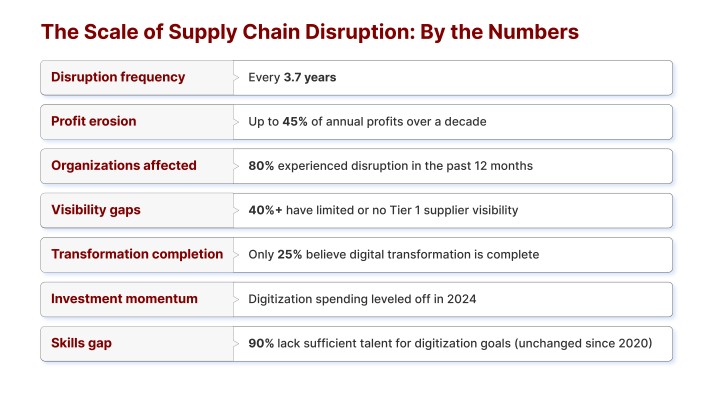
Despite overwhelming evidence of risk and clear patterns of disruption, most organizations are implementing fewer resilience measures today than they were two years ago. This creates a dangerous gap, with supply chain shocks accelerating while defensive investments decline.
Traditional responses to this crisis, such as upgrading ERP systems, implementing control towers, and hiring more planners, haven’t solved the fundamental problem. They optimize within existing silos rather than eliminating the silos themselves. What’s needed is an entirely different approach.
The Power of Orchestration
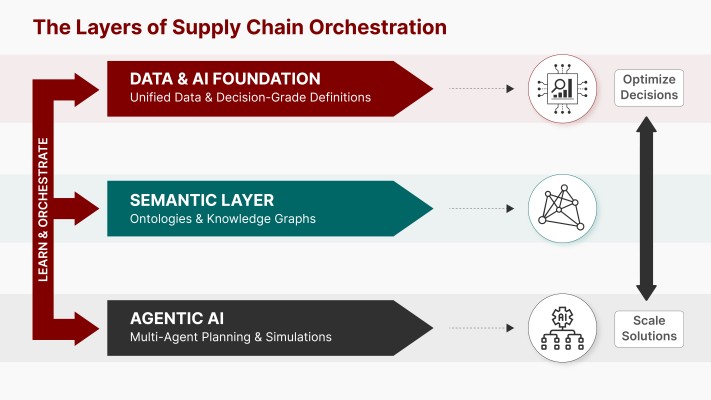
Orchestration is an antidote. Unlike traditional approaches that optimize functions sequentially, orchestration treats the entire value chain as one connected model, a living decision system that can simulate trade-offs in real-time, choose optimal actions, execute those choices, and then learn from outcomes to improve continuously, bringing an architectural difference to existing approaches.
What makes it “living”? Traditional supply chains are static: designed once, changed rarely, and optimized locally. A living decision system, by contrast, continuously senses changes in demand, capacity, costs, and constraints, then dynamically adjusts plans across the entire network. It learns from every decision, such as which suppliers over-delivered, which promotions cannibalized margin, and which routing decisions saved cost. Such institutional memory compounds over time, turning volatility from a threat into a competitive advantage.
In fact, most “control towers” fail because speed without meaning becomes a source of confusion. The potential for further digitization remains enormous, as much of its benefit remains untapped.
The contrast between Unilever’s demerger and the orchestration path is stark. While Unilever chose separation, companies like PepsiCo are proving that even massive, complex operations can be unified through orchestration. In January 2026, PepsiCo announced a first-of-its-kind initiative for a global CPG company applying digital twins to reshape how plant and warehousing facilities are digitally simulated and tested, with early pilots already underway in the US.
The digital-first strategy delivered stellar results. Initial deployment delivered a 20% increase in throughput, nearly 100% design validation, and 10-15% reductions in capital expenditure by uncovering hidden capacity and validating investments in a virtual environment.
These results came within months and without requiring massive capital investment in new physical infrastructure. By validating designs virtually before breaking ground, PepsiCo avoided the typical trade-off between speed and accuracy. More importantly, they created reusable capabilities that can now be deployed across their global network.
The WEF also suggests that generative AI can transform 43% of total working hours in supply chain roles. In contrast, in operationally intensive sectors like manufacturing and retail, 39% to 58% of work could be automated. Consumer goods research shows the upside of automating planning with human oversight, including a 4% increase in revenue, inventory down by up to 20%, and supply chain costs down by up to 10%.
Yet 90% of supply chain leaders say their companies lack sufficient talent and skills to meet digitization goals, a figure that has not changed significantly since 2020. This persistent skills gap is precisely why orchestration frameworks have gained traction; they’re designed to amplify human expertise rather than replace it.
The Mu Sigma approach addresses this challenge with a decision stack that turns volatility into a compounding advantage.
- L1: Data and Artificial Intelligence Foundation – standardizes definitions, ownership, and decision-grade data so teams debate choices, not reality.
- L2: Semantic Layer – Business Ontologies and Knowledge Graphs teach systems what “service level,” “fill rate,” “promotion,” and “substitution” mean in your business, so automation respects constraints and speaks your language.
- L3: Agentic AI Layer – multi-agent workflows using specialized agents propose plans, stress-test constraints, run scenarios, and log decision rationale so governance and learning stop being afterthoughts.
All these layers work together and learn with feedback loops.
How Orchestration Works in Practice
Orchestrated planning treats the supply chain like a market where every choice has a price, a risk, and an opportunity cost. The goal is optimal decisions under uncertainty. Should you expedite a shipment to avoid a stockout, or accept the service hit and protect margin? Orchestration quantifies these trade-offs in real-time.
Execution puts the biggest decisions on rails: what to make, where to make it, where to hold inventory, what to substitute, what to expedite, and what to delay. Rather than leaving these choices to individual planners making isolated decisions, the system evaluates all options simultaneously and recommends the path that optimizes network-wide outcomes.
Governance closes the loop by tracking when reality diverges from plan, automatically triggering re-simulations, and maintaining an auditable decision trail. Every recommendation includes a clear rationale: why this option was chosen over alternatives, the constraints considered, and the trade-offs made. Transparency is essential for both continuous improvement and organizational trust.
Results follow when the organization stops rewarding local wins and starts rewarding global outcomes, because margin is a network effect, and so is service.
Beyond the operational improvements, orchestration delivers a strategic advantage by increasing the percentage of employees who can operate at the “seams” of technology and business problems by understanding how to leverage AI and machine learning for the greatest business benefit. Organizations facing complex problems need to build digital “fluency” across functions, and digitally fluent organizations are three times more likely to have experienced high revenue growth over the past three years.
All Work of the Future is Network
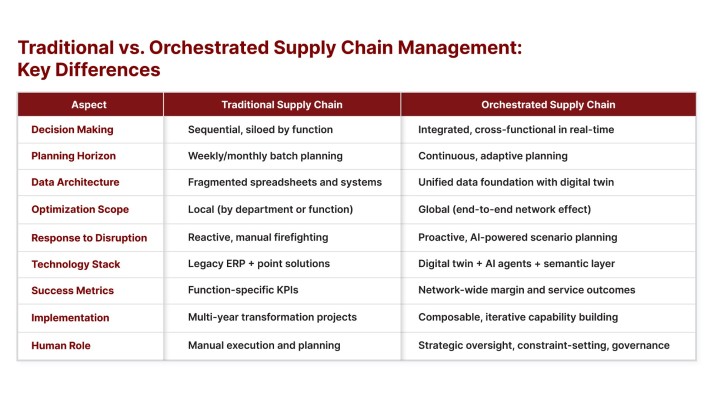
Technology is only half the solution. Harnessing orchestration requires not just digital investment and upskilling but fundamentally rethinking the organizational model. Companies with traditional, siloed structures often struggle to develop the flexibility needed to integrate analytical and statistical skills with an enterprise-wide focus. In an age of constant disruption, the advantage goes to companies that view their supply chains as end-to-end networks that plan, respond, and coordinate in an integrated fashion, rather than as a set of independent functions.
Cross-functional teams with a view of the entire enterprise are better at using powerful tools and data to connect the dots between planning, sales, customer service, and other critical functions. This networked approach is essential because results follow when the organization stops rewarding local wins and starts rewarding global outcomes; margin is a network effect, and so is service.
The question facing every CPG leader is whether to lead this shift or be forced to follow. Companies implementing orchestration today are achieving 20%+ operational improvements in months while building capabilities that will define competitive advantage for the next decade. Those waiting for disruption to stabilize are making a costly bet that their siloed, manual, reactive supply chains can outlast competitors with integrated, AI-powered, proactive networks.
The choice is clear. The window to act is closing. The disruption cycle has already begun.
FAQ
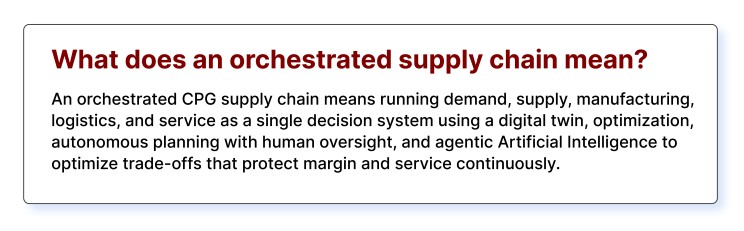
- How is orchestration different from traditional supply chain management?
Orchestration connects decisions across the full value chain and updates choices as conditions change, while traditional management optimizes functions in silos and reacts after the fact. - Where should a CPG company start?
Start with the decisions that bleed margin fastest, usually promotion demand swings, inventory placement, and transport consolidation, then scale the decision stack so each win becomes repeatable. - How do humans stay in control with autonomous planning and orchestration?
Humans set objectives, constraints, and escalation rules, while systems run scenarios and propose actions, and every material decision is reviewable with a clear rationale and audit trail. - What is the business case for acting now?
McKinsey links month-plus disruptions to major profit erosion over time, and its CPG planning research quantifies the upside of autonomous planning, making delay a compounding cost rather than a neutral choice.
Related Articles