
Aluminum Market Volatility and Decision Lag: The Hidden Threat to Industrial Margins
- Read Time: 7 Min
-


On August 20, word from Washington that tariffs on some Canadian aluminum would come down knocked 8.2% off the September Midwest premium in a single day, to $0.95 a pound. The October and November contracts fell more than 12%.
No smelter had changed its output, and no new metal had come to market. The policy itself hadn’t changed. Buyers and sellers had simply revised what they expected, and the price followed.
For anyone buying, selling or processing aluminum, the harder part came next. The market had repriced, but the business still had contracts to honor, quotes out with customers and metal in inventory bought at yesterday’s prices. A signal like that tells you something has changed. It doesn’t tell you what to do about it.
That gap, between a market that reprices in a day and a business that has to work out what the move means for it, is where a lot of commercial value gets lost. It’s what this piece is about.
Why does one price move trigger four different decisions?
Take a manufacturer buying aluminum for customer orders. The same price drop looks different from every desk.
| Team | What they see | What they’re protecting |
|---|---|---|
| Procurement | A chance to buy cheaper | Cost of metal |
| Commercial | Open quotes and fixed customer commitments | Margin, and the order itself |
| Supply chain | Inventory in transit, delivery dates | Availability and service levels |
| Finance | Stock bought at yesterday’s price | Working capital and profitability |
Every one of these views is fair, and none of them is enough on its own. Buying later might capture a lower price but could put a delivery at risk. Holding stock protects service but leaves you carrying metal bought at a higher cost. Revising a quote protects margin but might lose the order.
So the real question isn’t whether aluminum will get cheaper. It’s which move makes sense given what the company has already committed to.
Our view is that the organizations that handle aluminum volatility well are not necessarily the ones gathering data fastest. They are the ones best at connecting market signals with procurement, inventory, customer commitments and prior decisions. That connected decision context is the challenge Mu Sigma addresses through its Field of Context (FoC) approach, covered below.
Is the LME price what aluminum buyers actually pay?
The LME (London Metal Exchange) price is a benchmark rather than your delivered cost. Regional premiums, duties, freight and contract terms sit on top of it, and they don’t all move together.
According to Constellium’s Q2 2026 Form 10-Q, here is how far apart the components drifted against the same quarter in 2025:
| Measure (Constellium reported average) | Change vs Q2 2025 |
|---|---|
| LME transaction price | +46% |
| Midwest premium | +154% |
| All-in US aluminum price | +77% |
Three measures, moving at three different speeds. These are one company’s numbers and won’t match every buyer’s exposure, but they show why a single benchmark can’t tell you what you’re really paying. Trade policy is only one of the forces at work. Several forces shape what a buyer actually pays, and each one touches a different decision:
| Driver | How it reaches your cost | Decision it touches |
|---|---|---|
| Trade policy | Duties and the regional premium | When to buy, how long to hold quotes open |
| Energy | Smelting and conversion costs, especially in Europe | Contract terms, metal pass-through |
| Carbon (EU CBAM) | Carbon cost on imports into the EU, in its definitive phase since January 2026 | Sourcing mix, supplier choice |
| Scrap and demand | Scrap tightness narrows the gap to primary metal; solar, EV and construction demand supports volume | Inventory cover, scrap vs primary mix |
What is decision lag, and where does it hide?
Decision lag is the time, and the options, a business loses between a market signal and a coordinated, committed response.
Organisations often think of decision lag as the time one person takes to approve something. In practice it builds up across the whole chain: spotting the signal, sizing the exposure, comparing options, getting teams aligned, getting approval and then executing.
The market update may reach the right desk within minutes. Then the real questions start:
- Which purchases can still be changed?
- Which customer commitments are fixed?
- Does the inventory we hold change the economics of buying now?
- Are Procurement, Commercial and Finance working from the same assumptions?
- Who has the authority to act?
The answers are scattered across trading updates, procurement systems, inventory records, contracts, finance teams, spreadsheets and conversations. The data is usually there somewhere, but pulling it together takes repeated analysis and a lot of coordination.
Meanwhile, options start to expire. A sourcing opportunity narrows, a customer quote goes stale, and inventory gets bought on assumptions that no longer hold. The real cost isn’t the time spent in meetings, it’s the options lost while the business works out where it stands.
Speed matters in a volatile market, but speed without context just gets you to the wrong action sooner.
What is decision context, and why is it missing?
Decision context is the record of what an organization observed, how it read the situation, what it decided and what happened next.
Most businesses can tell you what happened. Purchase orders, transaction prices, inventory levels, quotes and delivery performance are all on file.
What they rarely hold is why. A system will show that a supplier was chosen, a purchase delayed or a quote revised. It rarely shows which alternatives were weighed, what the team believed about the market that week, which constraint mattered most, or why one trade-off won out over another.
So when the next signal arrives, teams end up rebuilding yesterday’s reasoning before they can decide today’s. That’s less a data shortage than a decision-context problem.
Mu Sigma’s Field of Context (FoC) is an approach that represents organizational reality by connecting context across entities and over time, including the perceptions, decisions and actions behind business outcomes. In the aluminum example, the premium move would be read alongside the sourcing position, open customer commitments, the assumptions behind the last purchase, the trade-offs accepted and what happened next.
This matters for Enterprise AI as well. A system with years of transaction history but none of the reasoning behind it can see what happened without knowing why. A connected context layer won’t replace judgment or accountability, but it gives both a richer foundation and lets the next decision start from what the last one learned.
What should aluminum leaders do first?
You don’t need to redesign every process. Take one decision where a market move hits your margin, such as when to buy metal, when to revise a customer quote or how much inventory to carry, and trace it through five stages. Each one is a place where time and context can leak.
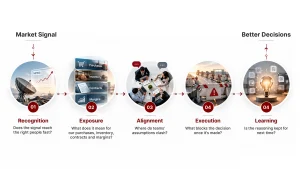
Each answer points to a different root cause, whether that’s missing information, fragmented context, unclear ownership, approval limits or execution gaps. It also gives you a better scorecard than speed alone: understand your exposure earlier, weigh options with the right context, make a call you can defend, and learn from the outcome.
The Strategic Imperative: Institutionalizing Memory
For industrial leaders, volatility is no longer a temporary market condition to survive, it is a permanent stress test of institutional agility. Speed without alignment is just a faster route to the wrong action. The true competitive advantage belongs to organizations that can eliminate decision lag by bridging the gap between market perception and corporate execution.
This is the core promise of Mu Sigma’s Field of Context (FoC). By linking what an organization perceives, decides, and executes into a single cohesive layer, FoC converts isolated data points into institutional memory. It ensures that when the next market shock arrives, your procurement, commercial, and finance teams aren’t wasting critical hours rebuilding yesterday’s reasoning. Instead, both your human leaders and enterprise AI systems can act instantly, leveraging the collective wisdom of every trade-off the company has ever made.
Ultimately, the goal is not just to close the decision lag. It is to ensure that your organization learns faster than the market changes.
Sources
- Bloomberg, “Aluminum Premium Slips as US Set to Cut Tariffs on Canada Metal” (Aug 20, 2026): the 8.2% fall in the September Midwest premium to $0.95 a pound, and the 12%+ drop in the October and November contracts.
- Constellium Form 10-Q, quarter ended June 30, 2026: average LME transaction price +46% ($3,571 vs $2,448 per ton) and average Midwest premium +154% ($2,518 vs $990 per ton). The +77% all-in US price is our calculation from those two lines ($6,089 vs $3,438 per ton).
- European Commission, Carbon Border Adjustment Mechanism: the CBAM definitive period started on 1 January 2026.
FAQ Section
What is aluminum price volatility?
Aluminum price volatility refers to fluctuations in aluminum prices driven by factors such as trade policy, regional premiums, energy costs, supply conditions and demand. These movements can affect procurement costs, inventory values and commercial margins.
How does aluminum price volatility affect procurement decisions?
Price volatility can change the economics of purchasing, supplier selection, inventory holding and contract negotiations. Effective decisions require understanding price movements alongside existing purchase commitments, customer obligations and supply constraints.
How does aluminum market volatility affect profitability?
Aluminum price movements can impact procurement costs, inventory valuation, customer pricing, and working capital, making rapid and coordinated decision-making critical.
What is decision lag in supply chain and commercial operations?
Decision lag is the time between recognizing a business signal and executing an informed response. It can accumulate through exposure analysis, cross-functional coordination, approval processes and execution delays.
Why does decision context matter for enterprise AI?
Decision context helps enterprise AI interpret information in relation to business objectives, constraints and prior outcomes. It complements transaction data and human judgment rather than replacing accountability for decisions.
What is decision lag in commodity markets?
Decision lag is the delay between a market event and a business response. It often occurs when organizations must align procurement, commercial, finance, and supply chain teams before acting.
Why is decision context important for enterprise AI?
Decision context helps AI systems understand why previous business decisions were made, enabling more accurate recommendations during future market disruptions.
How does Mu Sigma’s Field of Context help industrial companies?
Field of Context connects decisions, assumptions, trade-offs, and outcomes across business functions, creating institutional memory that improves decision quality and speed.
How can Field of Context help organizations make better decisions?
Mu Sigma’s Field of Context connects organizational context across entities and over time, including perceptions, decisions and actions. This can help decision-makers understand previous trade-offs and use that context when evaluating new business situations.
Related Articles