This Mistake is DESTROYING Your Supply Chain Margins
- Todd Wandtke
- Read Time: 5 Min
-


Would You Run an Airline That Treats Fuel and Peanuts as Equal Cost Centers?
In 2021, automakers slowed or halted production because small semiconductors were missing, and the shortage was estimated to cost the industry about $210 billion in lost revenue, pushing price pain onto millions of buyers. That episode was a hotspot failure. A tiny input was so critical, but procurement budgets treated it like any other commodity line item.
Research from National Institute of Standards and Technology (NIST) shows such a pattern is normal, not rare, because most high-impact supply chain costs, labor, and environmental costs concentrate in a small share of categories. (BTW, returns concentrate the same way.)
NIST also reports that 20% of investment categories represent 82% of net present value (NPV), and 20% of cumulative investment cost accounts for 74% of NPV, so treating investments equally is a mathematically elegant way to underperform.
20% of supply chain entities account for 89% of value added, 89% of labor hours, and 91% of environmental impacts.
Similarly, an automobile cost mapping case study by the International Input-Output Association reports 20% of supply chain entities account for 89% of value added, 89% of labor hours, and 91% of environmental impacts, which is the inequality your budget and procurement process pretends does not exist.
Leaders should care about that 20% and take great care to protect it. Do not treat the supply chain as a collective expense. It turns decision-making into charity, where money gets spread thin to keep everyone calm instead of moving the needle in the right direction.
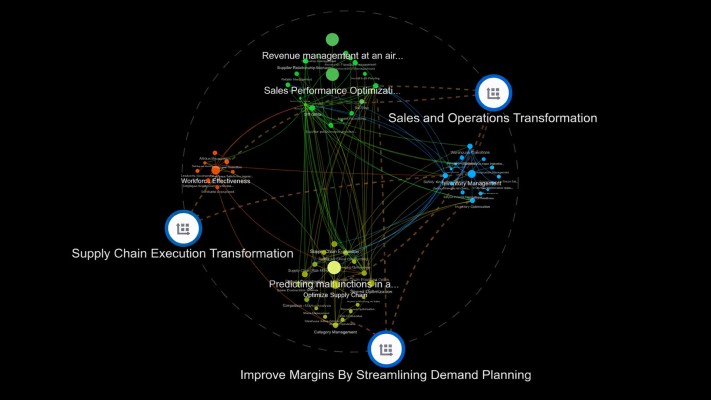
Systems thinking fixes that because it forces a map of the whole problem space, not a series of disconnected projects. Systems thinking works because supply chains behave like networks, where one decision triggers second- and third-order effects across demand planning, inventory, service levels, and execution. Mapping the whole problem space makes those links visible.
The image below shows how we adopt systems thinking and graph theory to map a supply chain problem space for our partners at Mu Sigma. You can see how connections reveal the bigger picture and help manage the system by focusing on solving interconnected problems.
The River of Reasonable Return
Systems thinking reveals the connections. But once you’ve mapped how problems interact, you still need a way to decide which connected problems to fix first, because some hotspots compound faster than others.
Our founder Dhiraj Rajaram often talks about the River of Reasonable Return, which frames the problem space using two questions: how often a problem happens, and how much impact a fix creates.
Low frequency and low impact problems form the Barren Desert of Low Return, where teams burn time polishing operations that never impact the income statement.
High frequency and high impact problems look like the Fertile Land of Disproportionate return, but everyone chases them, so competition is brutal and returns frequently disappointing.
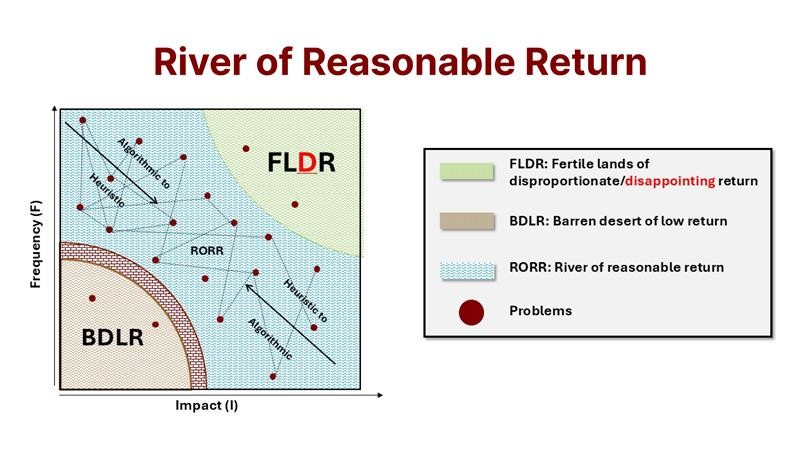
“Problems are not one or two big problems but many, many, many small problems that are interacting with each other.” – Dhiraj Rajaram, Founder and CEO, Mu Sigma.
Real money lives in the river between them, where many smaller, connected problems create compounding drag, and steady fixes create compounding advantage. Inside that river, high frequency and lower impact work needs a machine mindset, while low frequency and high impact work needs a human mindset, and the winning operating model blends both humans and machine into an Iron Man mindset.
The River of Reasonable Return is where supply chain leaders must live, because most value comes from fixing the connected, repeatable frictions that quietly tax every order, every day. It reinforces NIST’s point to start funding the few moves with the highest odds of return, rather than spreading money across the whole cost-center map.
By mapping problems and identifying which ones to tackle first, you can flag high internal rate of return (IRR) themes like bottleneck reduction, scheduling, and just-in-time inventory. Leaders can use it to plan hotspot problems before scaling playbooks across the network. Without a way to identify and map hotspots (i.e. value driver) to prove payback fast, budgets drift toward loud projects and fashionable “big bets,” rather than the interventions that compound.
Mu Sigma helps operationalize problem mapping as a decision operating system, where humans frame the problem and choose the bets, and machines simulate trade-offs, track outcomes, and surface drift, so the organization keeps getting smarter. We call the approach Continuous Service as a Software (CSaaS) and the framework The Art of Problem Solving System (AoPSS).
At Mu Sigma, we have learned to treat cost mapping as the front door to a decision-making system for supply chains, where decisions get simulated, audited, tested, monitored for drift, and improved continuously.
Here’s what that looks like in practice. A procurement team identifies a bottleneck such as frequent stockouts of a critical component. Instead of commissioning a month-long study, they run a simulation that tests three scenarios (higher safety stock, dual sourcing, or lead time reduction) against historical demand patterns. The system flags which option best balances cost, service level, and risk.
Once implemented, it monitors actual performance weekly, alerts the team when results drift from the model’s prediction, and automatically queues a re-simulation when supplier lead times change by more than 10%. The insight doesn’t expire because the system is designed to keep learning.
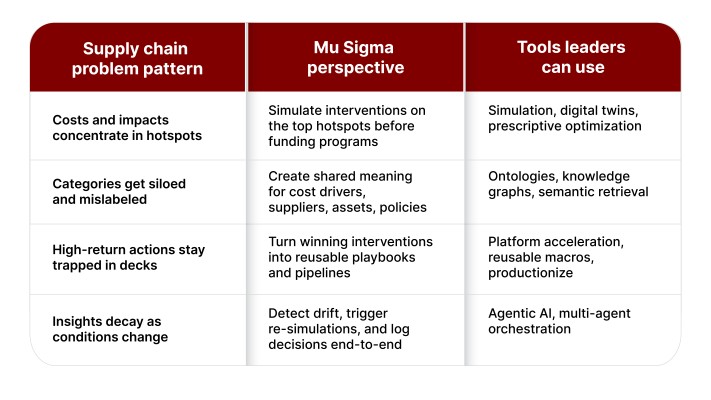
The image below shows the operating logic in finding the hotspots, giving every category shared meaning, turning winning fixes into reusable playbooks, then keeping performance from drifting as demand, suppliers, and policies change.
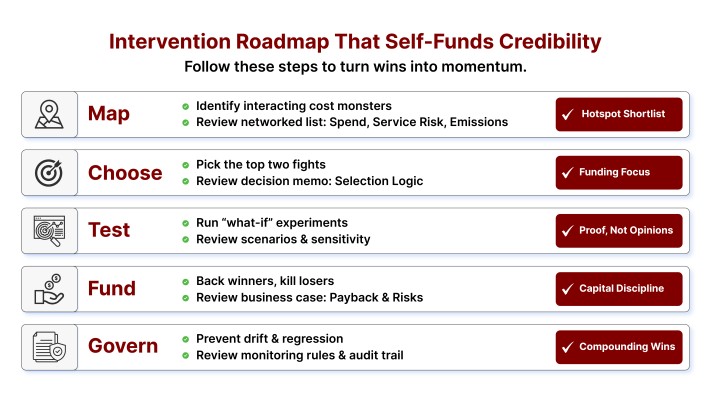
A supply chain becomes a networked system when leaders run that learning-doing loop on purpose, because simulation reduces regret, knowledge structure reduces siloes, production platforms reduce reinvention, and orchestration reduces decay
Early wins fund the next wave, and compounding learning creates the only moat that tariffs, shocks, and competitors cannot copy quickly.
Stop funding your supply chain like every line item deserves a medal, and start acting like a leader who can choose. Build a decision loop that keeps learning, keeps auditing, and keeps watching for drift, because the next shock is already in motion and your margin will not forgive equal-treatment budgeting.
FAQ
- What is supply chain cost mapping?
Supply chain cost mapping ranks categories or entities by their contribution to cost, labor, and impact so leaders can target hotspots instead of funding everything equally. - What does NIST’s Pareto finding mean in plain English?
Pareto in supply chains means a small slice of suppliers, categories, or activities drives most of the outcome, so hotspot work beats broad “transformation” work. - Which interventions tend to generate high returns first?
NIST cites bottleneck reduction, scheduling, and just-in-time inventory as high-IRR areas, which usually means flow and planning fixes beat shiny tech rollouts. - Why do supply chain programs fail even with good analytics?
Programs fail when insight is treated as a one-time report, because no system exists to test interventions, scale winners, and monitor drift as conditions change. - Where does Mu Sigma fit for a Fortune 500 supply chain leader?
Mu Sigma helps build an Iron Man operating model where humans set intent, machines run simulations and monitoring, and the organization compounds learning into reusable decision playbooks. - What is the first practical step a leader can take next week?
Pick one value stream, map the top ten cost and service risks as a connected network, then fund only the top two experiments with clear kill criteria and an audit trail.
Related Articles