Data Analytics in Healthcare: Patient Outcomes and Predictive Care
- Read Time: 5 Min
-


On paper, the discharge was perfect. The surgery was successful, vitals had stabilized, and the bed was cleared for the next admission. The hospital booked the revenue.
But 72 hours later, that same 70-year-old patient was back in the Emergency Department. The successful discharge was a mirage.
Medicare penalizes the hospital with high 30-day readmission rates under the Hospital Readmission Reduction Program (HRRP).
Hospitals can lose up to 3% of all Medicare payments for a year if rates are too high.
For decades, healthcare has operated on “Clinical Intuition.” We trusted the experienced physician to sense when a patient was ready to go home. And for simple cases, that works. However, modern patient data is a complex combination of comorbidities, social determinants, and subtle physiological changes. A human doctor, reviewing a chart for fifteen minutes, cannot process the invisible patterns hidden in years of medical history. They see what is visible.
But the risk and the financial bleed lie in the invisible.
Why Clinical Efficiency is a Financial Metric
We are moving from sick care (treating the failure) to risk management (preventing the failure).
The U.S. healthcare system currently bleeds between $15 billion and $20 billion in annual costs due to unplanned hospital readmissions. For a sector where operating margins frequently hover around 3%, absorbing a high readmission rate is financially unsustainable. In this context, predictive models become margin-protection assets.
Predictive models that risk-stratify patients before discharge can reduce readmission rates by 15% to 20%, resulting in direct revenue savings.
Getting Into the Operating Room
While readmissions capture the headlines, the actual engine of hospital profitability, and a massive opportunity for predictive optimization, lies in the Operating Room (OR).
The OR is expensive real estate in healthcare. Running an OR costs an estimated $50 to $100 per minute. When a scheduled surgery creates a “gap” because a procedure finishes early or a patient cancels at the last minute that idle time is considered perishable inventory. You cannot sell yesterday’s empty slot today.
In the traditional model, the “Block Time” fallacy comes into play, where surgery blocks are assigned based on surgeon hierarchy. Senior surgeons get prime blocks regardless of their actual utilization. This leads to the “sandbagging” effect, in which surgeons overestimate procedure times to avoid being rushed, leaving valuable OR hours unused.
Leading healthcare systems have transitioned from static scheduling to predictive utilization models. Instead of asking the surgeon, “How long will this take?”, the model can analyze the surgeon’s last 50 procedures, the patient’s key health metrics, and the specific procedure complexity to forecast the actual duration.
By using these predictive operational models hospitals can release unused “block time” in advance, leading to efficiency gains across OR utilization and increased revenue.
The argument for predictive analytics often gets lost in a sea of buzzwords. But for the COO and CTO, the proof lies in asset utilization.
Three High-Value Use Cases
If the goal is to optimize the balance sheet, the predictive lens must widen beyond the OR and readmissions to the broader operational machinery.
Workforce Optimization (The Burnout Metric)
Hospitals today bleed cash on overtime and personnel staffing because they staff based on “averages.” But hospitals are not regular workspaces where an “average” works. Cleveland Clinic used predictive analytics to optimize nursing and paramedic staffing. The hospital’s ED “experienced a 70% reduction in LWBS [leave without being seen] from baseline after completing its predictive analytics project.” Predictive analytics enabled the hospital to adjust staff levels as needed and scale back when necessary.
Revenue Cycle Optimization (The Cash Flow Engine)
It is no coincidence that financial analytics currently commands 37% of the healthcare analytics market share. Knowing a claim will be denied before you send it changes everything. Instead of spending months fighting for payment, predictive engines flag errors in real-time, allowing businesses to get paid faster and keep cash flowing steadily.
The Sepsis Protocol (Speed as Currency)
Sepsis kills 270,000 Americans annually and costs the system $38 billion per year. Detection often happens too late. Mortality risk increases by 7.6% for every hour treatment is delayed. Predictive analytics in healthcare can flag sepsis risk 4-6 hours earlier than clinical observation by detecting subtle micro-changes in creatinine and heart rate variability. It buys time. And in medicine, time is the only non-renewable resource.
Additional Opportunities
Beyond the three hospital examples above, predictive analytics is improving Clinical Trials.
Clinical Trial Optimization
Developing a new drug can take over a decade and cost billions, often failing due to poor site selection or inadequate patient recruitment. Mu Sigma helped a major pharmaceutical company transform its clinical trial management using an NLP-driven benchmarking engine. The 80% reduction in time to identify comparator studies enabled the R&D team to simulate disruptions and optimize protocols before the first patient was enrolled.
Challenges, Risks, and Limitations
The Data Silo Paradox
Patient healthcare data is fragmented and highly regulated. Often, departments are not in lock-step with advancing technology. Departments may mature at different speeds. Radiology might be using cutting-edge cloud imaging, while the pharmacy runs on an on-premise system from 2010, and Physical Therapy relies on manual entry. When these platforms fail to “handshake,” the patient narrative becomes fractured. The result is fragmented patient data that impacts patient experience and hospital performance, including profitability.
The Black Box Problem
A single predictive score often fails because different stakeholders view the same data differently. A “High Risk” flag means one thing to a CFO (financial reserve required) and something entirely different to a Chief Medical Officer (clinical intervention required). A Standard “Black Box” AI offers a binary output that satisfies no one. The solution lies in Explainable AI (XAI). A physician will never trust a “Black Box” that spits out a risk score without context. XAI solves the “Physician Trust Deficit” by showing the work: “Patient A is flagged as High Risk because of a combination of rising creatinine levels, a 10% increase in body weight, and two missed appointments.” When doctors understand the why, adoption rates soar.
Algorithmic Bias
If a model is trained on historical data where access to care was uneven, it will learn to associate “low utilization” with “low risk”, when in reality, it might just mean “lack of insurance.” Using “healthcare spend” as a proxy for “sickness” inherently biases algorithms against lower-income populations who spend less but are often sicker. Careful consideration must be given to ensure that your data sets, which train the models, are representative of the population.
The choice is no longer whether to adopt predictive analytics, but how fast. In a landscape where margins are thinning and patient complexity is rising, systems that rely on hindsight will inevitably fail. The future belongs to those who can see the storm before it hits and adjust their course accordingly.
FAQs
Benefits of predictive analytics in healthcare
Predictive analytics in healthcare shifts the paradigm from reactive treatment to proactive prevention. It reduces mortality rates by identifying deteriorating patients early (e.g., sepsis alerts), lowers operational costs by optimizing hospital staffing and supply chains, and improves patient satisfaction through precision medicine analytics that tailor treatments to individual genetic profiles.
What is the future of predictive analytics in healthcare?
The future lies in the “Digital Twin” and autonomous care loops. Data analytics in healthcare will evolve from providing alerts to simulating treatment outcomes on virtual models before implementation. We will see a shift toward continuous, real-time patient monitoring in home settings, making the hospital a decentralized network of data streams.
What are common use cases of predictive analytics in healthcare?
Key use cases include patient risk prediction for readmission (identifying individuals who are likely to return to the hospital), early sepsis detection, optimizing operating room schedules to reduce wait times, and utilizing AI predictive analytics in healthcare for diagnosing medical images. It is also critical in predicting disease outbreaks and managing population health.
What types of data are used in healthcare predictive analytics?
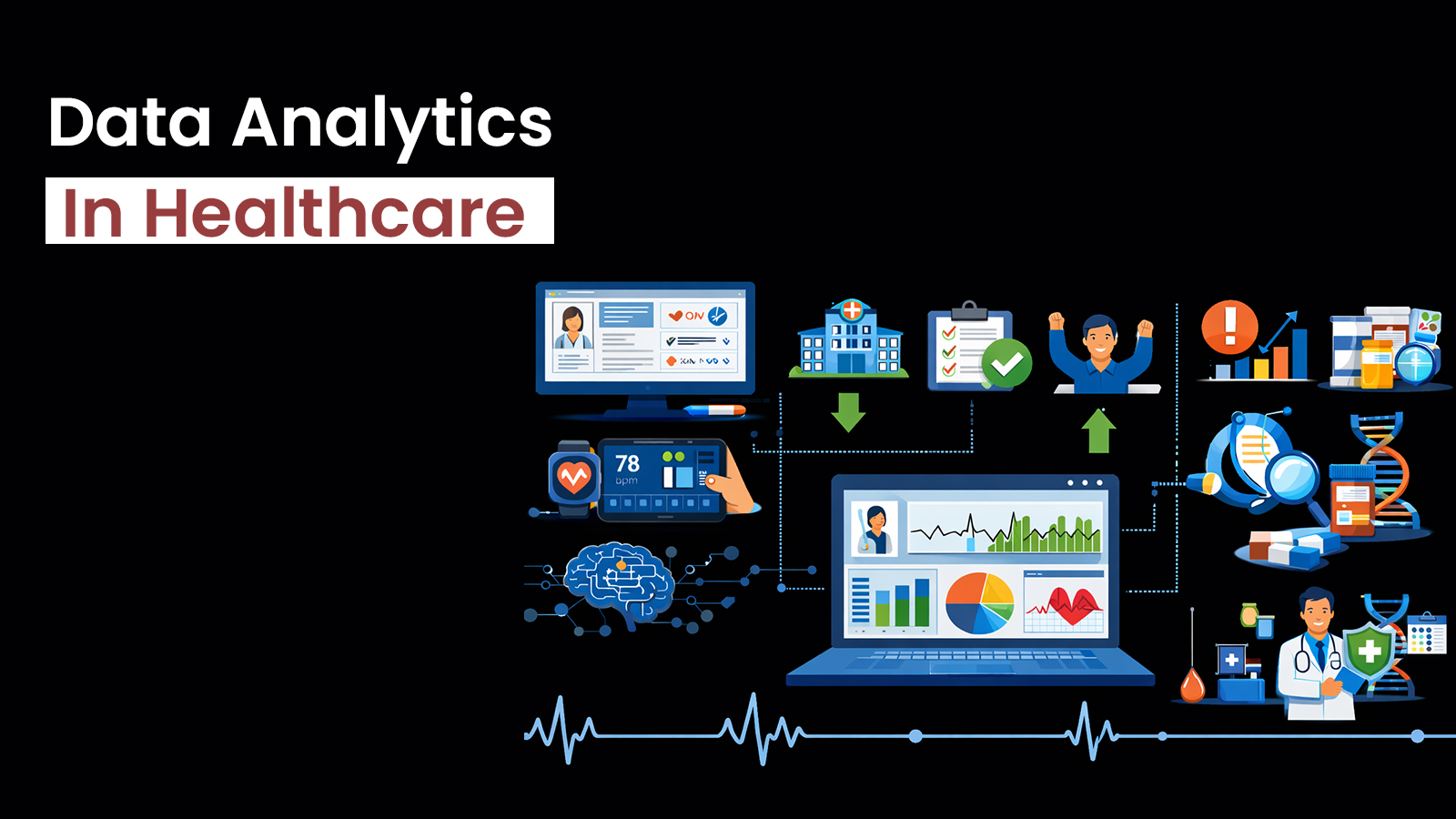
Healthcare data analytics ingests a complex mix of structured and unstructured data. This includes Electronic Health Records (EHRs), genomic data, real-time patient monitoring feeds (such as heart rate and O2 levels), administrative claims data, and increasingly, Social Determinants of Health (SDOH)—factors like housing stability and economic status that influence outcomes.
Related Articles