


Harvard Business Review warned that “fast and roughly right decision making will replace deliberations that are precise and slow,” and BI wins when it makes that trade safe and repeatable.
Mu Sigma’s Business Intelligence (BI) turns data into action by wiring decision loops into everyday work, so leaders stop debating yesterday and start steering tomorrow. At Mu Sigma, BI is about embedding decision-making reflexes across the enterprise.
We help Fortune 500 companies design and scale BI ecosystems that go beyond traditional reporting, transforming static dashboards into dynamic systems of learning, driven by continuous feedback, hypothesis validation, and business experimentation.
Design scalable, future-ready BI frameworks aligned with enterprise priorities, domains, and data maturity.
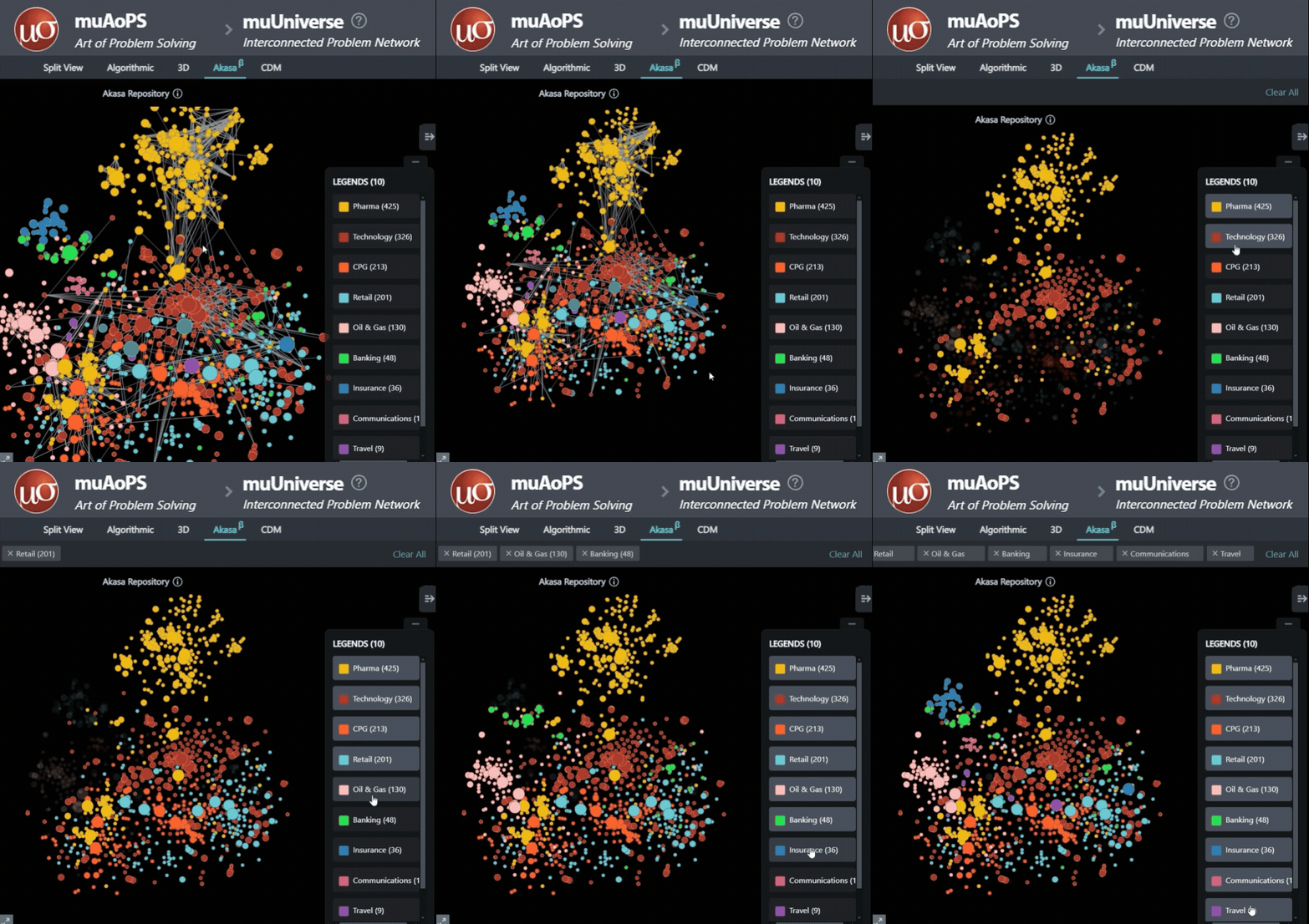
We translate business questions into context fields (graphs) using the Art of Problem Solving System (AoPSS), because data without a decision is just expensive trivia.
The industry is heavily regulated, so diligence is required to meet strict patient safety and privacy standards.
The industry is heavily regulated, so diligence is required to meet strict patient safety and privacy standards.
|
Traditional BI
|
Mu Sigma BI
|
|---|---|
| Static dashboards | Decision boards with feedback loops |
| Tool-first implementation | Problem-first design/First-principles approach |
| One-time delivery | Continuous learning system |
| Generic KPIs | Context-specific metrics |
| Analyst-led reporting | Business-owned decisions |
| Output oriented | Outcome oriented |

Inventory visibility, customer segmentation, demand sensing, and price and promotion performance tracking.

Anita Kulkarni is a contemporary Indian visual artist whose work explores identity, memory, and transformation

Anita Kulkarni is a contemporary Indian visual artist whose work explores identity, memory, and transformation

Vijender Sharma is a contemporary Indian visual artist whose work explores identity, memory, and transformation

A Fortune 500 pharma company replaced weeks of manual clinical concept mapping with automated, standards-aligned workflows. Mu Sigma compressed cohort creation from months to minutes, cutting error risk while unlocking scalable reuse across R&D programs.
reduction in concept set creation time
45 minutes per cohort
scalability across clinical phenotypes

Mu Sigma enabled cross-language scientific discovery by automating Key Opinion Leader identification across English and Japanese literature. AI-driven semantic search eliminated translation bottlenecks, accelerating insight flow and expanding global research reach.
increase in identified Key Opinion Leaders
reduction in manual search effort

To accelerate RSV vaccine approval, Mu Sigma applied prescriptive modeling to refine cohorts, surface hidden risk factors, and optimize trial execution. The result was faster insights, stronger evidence, and reduced time to regulatory confidence.
expansion in eligible patient cohorts
faster insight generation
high-density trial sites identified
Stop reporting the past and start building a BI system that thinks, learns, and improves decisions at scale. Partner with Mu Sigma to design Business Intelligence that reduces noise, increases decision velocity, and makes performance measurable where it actually happens.
Business Intelligence (BI) solutions turn enterprise data into trusted metrics, reports, and interactive dashboards so leaders can see performance, spot issues early, and allocate resources intelligently, forming the foundation for faster decision cycles.
Business Intelligence works by ingesting data from source systems, cleaning and modeling it, applying a semantic layer and governance, and delivering self-service analytics through dashboards and alerts, balancing speed, security, and a single version of truth.
Business Intelligence is important because it reduces decision latency, exposes variance in performance, improves compliance and auditability, and creates shared accountability through common metrics, aligning executives and teams around outcomes, not opinions.
Business Intelligence use cases include executive scorecards, sales and pipeline analytics, supply chain and inventory visibility, finance close and forecasting, customer service performance, and regulatory reporting, connecting each view to action rather than observation.
Business Intelligence platforms typically include data connectors, an extract-transform-load pipeline, a governed data warehouse or lakehouse, a semantic layer, visualization and reporting tools, role-based access control, and monitoring, with added decision workflows and quality checks to keep insights reliable.
Companies quantify return on investment from BI solutions through faster close cycles, fewer manual reports, improved forecast accuracy, better inventory turns, and fewer compliance surprises, using baseline-to-target productivity, error-rate, and business outcome deltas tied to accountable owners.